
When you type a word into Google, Wikipedia almost always appears among the first results, sometimes even in the information box on the right.
This is no coincidence. Behind this dominance is a specific metric: the visibility index, developed by the company Sistrix.
You’ll understand what it is, why Wikipedia outclasses everyone else… and what it means for your SEO strategy.
What is the Sistrix visibility index?
The visibility index is a score.
It measures the actual presence of a domain name in Google results.
In practical terms, Sistrix:
- analyzes millions of search queries
- observes the ranking positions of websites
- weighs results according to their real on-screen visibility
- and assigns an overall visibility score
It’s a bit like a stock market index for websites.
The higher the score:
- the more often you appear
- the higher you are
- the more visible you really are
👉 It’s not just “being first.” It’s being seen and clicked.
How does Sistrix calculate visibility?
Sistrix takes several factors into account:
- Mobile results (priority today)
- Top 10 Google results
- Exact position on screen (above or below the fold)
- Special blocks: images, videos, FAQs, shopping
A #1 position is not always worth another #1 position.
If you are first:
- but under 4 ads;
- a carousel of images;
- a “People Also Ask” block;
👉 Your actual visibility drops. Sistrix (among other tools) takes this into account.

Wikipedia: Google’s absolute champion
The Wikipedia domain dominates by a wide margin.
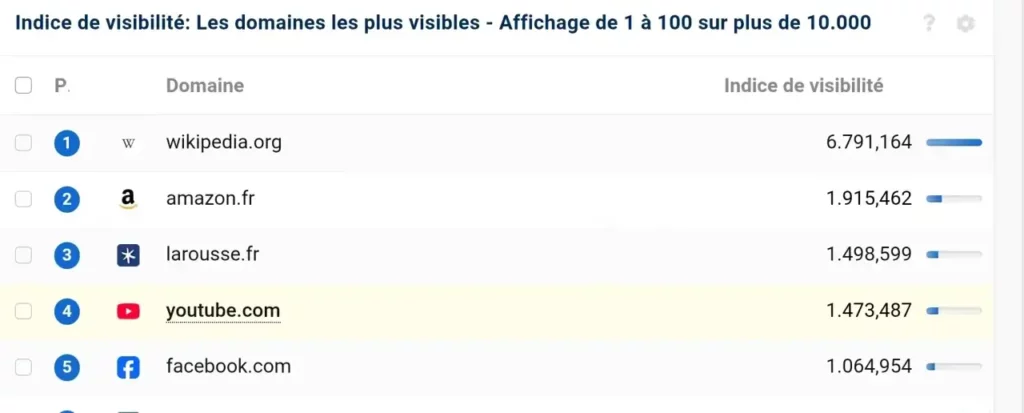
In France, the visibility scores of several major sites in 2025 were approximately:
- Wikipedia ≈ 6500 points
- Amazon ≈ 1800 points
- YouTube ≈ 1700 points
- Larousse ≈ 1400 points
- Facebook ≈ 1000 points
The gap is very wide.
And this is not specific to France. The same is true in Spain, Germany and Italy.
Wikipedia has been number 1 for as long as the index has existed.
👀Check your eligibility on Wikipedia with a notability audit
Request a comprehensive audit from us to determine your eligibility on the encyclopedia (delivered within 48 hours) or learn about alternative options that may be more relevant for your situation.
Why is Wikipedia ahead of the rest?
There are several reasons why Wikipedia is so highly visible in search engines (Google, Bing, etc.).
1️⃣ Massive content
- Millions of pages
- Daily updates
- Coverage of almost every subject
Each city, artist, date, concept, event…
Google loves it.
2️⃣ Informational search intent
Wikipedia responds to searches such as :
- definition;
- biography;
- explanation;
- historical context.
This is exactly what Google wants to offer.
No sales. No conversion. Just information.
3️⃣ The perfect structure for SEO
Wikipedia ticks all the boxes.
- Hierarchical titles
- Massive internal linking
- Editorial neutrality
- Historical authority (created in 2001)
- An extremely large number of inbound links
In many ways, Wikipedia has been a perfectly optimized SEO machine for more than 20 years.
4️⃣ A presence in the Google Knowledge Panel
See our full article on the Google Knowledge Panel.
You often see:
- a box on the right
- a photo
- a definition
- a Wikipedia source
This block attracts attention even before the traditional blue links.
Result: maximum visibility.
Should we try to “beat” Wikipedia?
In most cases, it doesn’t matter if your website ranks below your Wikipedia page.
Wikipedia dominates on:
- definitions ;
- biographies ;
- concepts ;
- informational queries.
But it is weak on:
- product comparisons
- shopping guides
- e-commerce categories
- transactional intentions
👉 Focus on what generates business.
✍️Need help making edits on Wikipedia?
We can answer your questions for free via email, or you can hire our services for personalized support on the encyclopedia. Take advantage of our 12+ years of experience on Wikipedia!
Is having a Wikipedia page good for your SEO?
Short answer: not really.
Links are nofollow. You don’t control the content. You may lose traffic to your own site.
On the other hand, it can be useful:
- to reassure investors, partners, customers or future employees;
- to give credibility to a manager;
- to strengthen a public or academic reputation.
Above all, it’s a lever for brand awareness.

Written by Albin Guillaud
A Wikipedia contributor since 2014, with Wikiconsult I support businesses, institutions, public figures, and agencies looking to create, update, or monitor their presence on Wikipedia.