
Grokipedia is an online encyclopedia launched by xAI, Elon Musk’s company, that operates similarly to Wikipedia but is generated by AI.
The real question for a company or an individual isn’t just whether they have a presence there, but whether that presence offers any real benefit in terms of visibility, reputation, and search engine optimization.
What is Grokipedia, who created it, and why?
Grokipedia is an online encyclopedia launched in late 2025 by Elon Musk, designed to compete with Wikipedia.
Powered by Grok, a generative artificial intelligence developed by xAI, it is presented as an alternative designed to correct the biases that Musk attributes to Wikipedia. It is available for anyone to view without having to create an account.
Unlike Wikipedia, its content cannot be edited directly by users.
While the project stands out for its very rapid production of articles, it has been criticized for:
- its reliability,
- the use of content that is sometimes very similar to that found on Wikipedia.
What are the main differences between Grokipedia and Wikipedia?
Here are the main differences between these two online encyclopedias.
| Criterion | Grokipedia | Wikipedia |
|---|---|---|
| Supported language(s) | English only | More than 300 |
| Has been in existence since | 2025 | 2001 |
| Number of articles | About 6 million items | More than 7 million articles in English, more than 60 million in total |
| Number of unique visitors per month | 5 million (source: Similarweb) | 3.5 billion (source: Similarweb) |
| How to Contribute | Articles generated and edited by the Grok AI model; suggestions are welcome, but direct editing is not allowed | Open editing available to everyone, provided they follow the contribution guidelines (which anyone can also edit) |
| Content License | Rights held by xAI | Content licensed under an open license (primarily CC BY-SA 3.0), freely reusable |
| Sources Used | Primary sources +++ (internal company documents, the person’s social media accounts) | Secondary sources (“independent” media) +++ |
👀Check your eligibility on Wikipedia with a notability audit
Request a comprehensive audit from us to determine your eligibility on the encyclopedia (delivered within 48 hours) or learn about alternative options that may be more relevant for your situation.
Is Grokipedia a highly trafficked website that ranks well in search engines (Google, AI)?
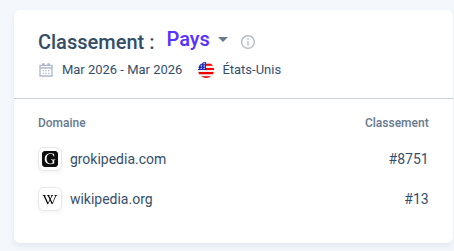
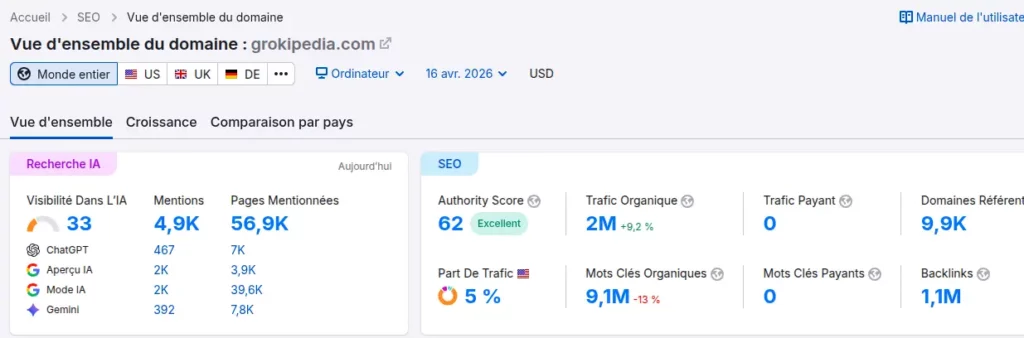
In March 2026, Wikipedia received 700 times more visits than Grokipedia.
Here are some statistics on Grokipedia’s traffic and search engine rankings, particularly in comparison to Wikipedia.
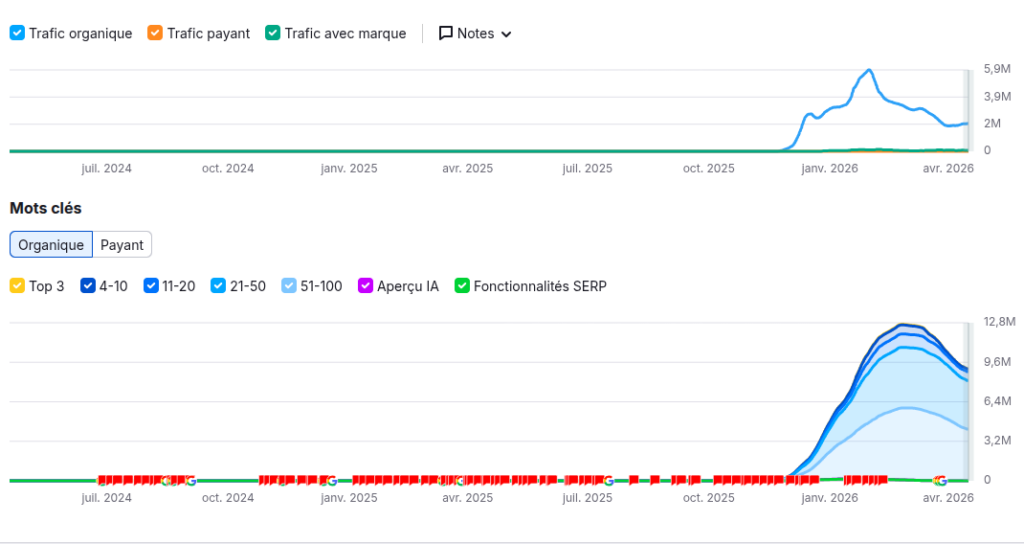
In addition, its traffic has been on the decline since the buzz surrounding its release:
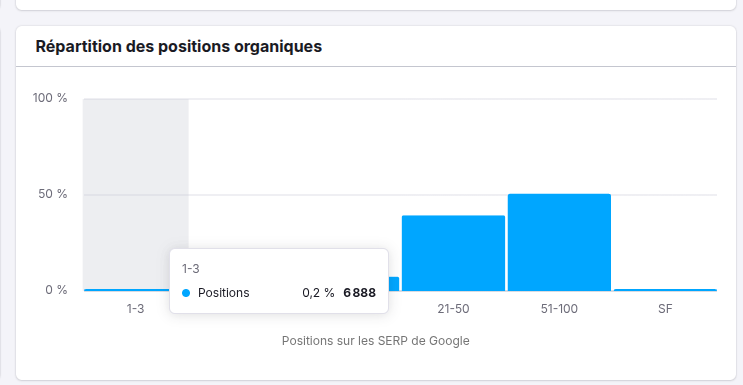
Grokipedia rarely appears in Google’s top search results, regardless of the keywords used. Only about 7,000 keywords rank between first and third place, compared to
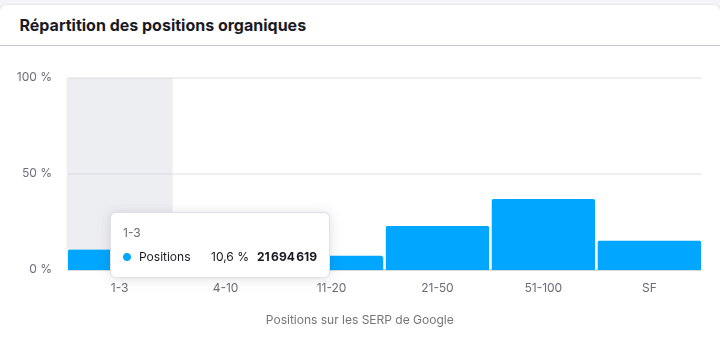
In contrast to Wikipedia, which has more than 21 million keywords ranking between the 1st and 3rd positions on Google— that’s 3,000 times more!
Finally, Grokipedia ranks significantly lower than Wikipedia in the results returned by generative AI systems such as ChatGPT (the most widely used).

Should you be concerned about your presence on Grokipedia?
Before taking any action, answer these four questions.
- Does your brand already have a dedicated article on Grokipedia?
- Is it mentioned in any articles (search: site:grokipedia.com “my brand” in Google)?
- Does the article contain any significant errors?
- Does the article actually show up in Google or in AI assistants when you search for your key terms?
If the answer to all four of these questions is “no,” then this effort is probably not a priority.
A presence on Grokipedia is primarily a sign of informational presence: if a page exists, it can help shape perceptions of the brand, without necessarily generating massive and steady traffic.
This topic should therefore be treated as a broader issue related to reputation and search engine optimization, not as a primary driver of customer acquisition.

Can we create a Grokipedia article that doesn’t exist?
You can suggest the creation of a new article.
Here’s how to do it.
- Create a (free)account on Grokipedia by entering your email address.
- Fill out the short form: You must provide the title of the article you want to create, and explain in a few words why this article should be on Grokipedia and what it should include.
- Click Submit.
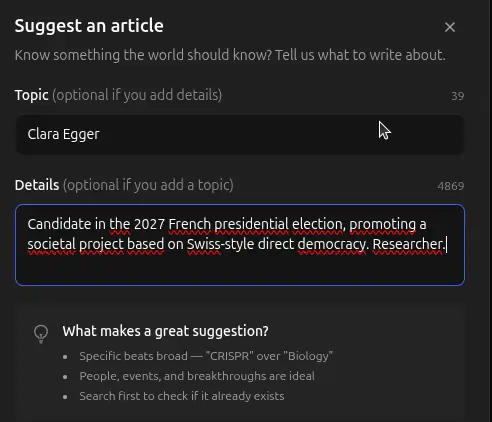
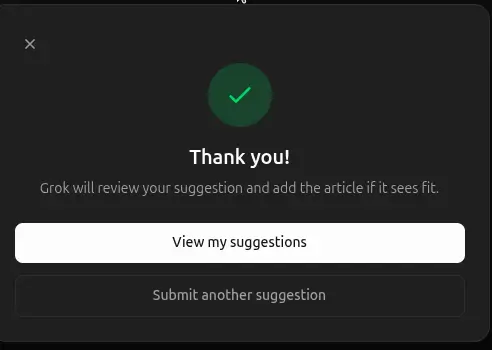
If it is approved, it will be posted online within a few hours.
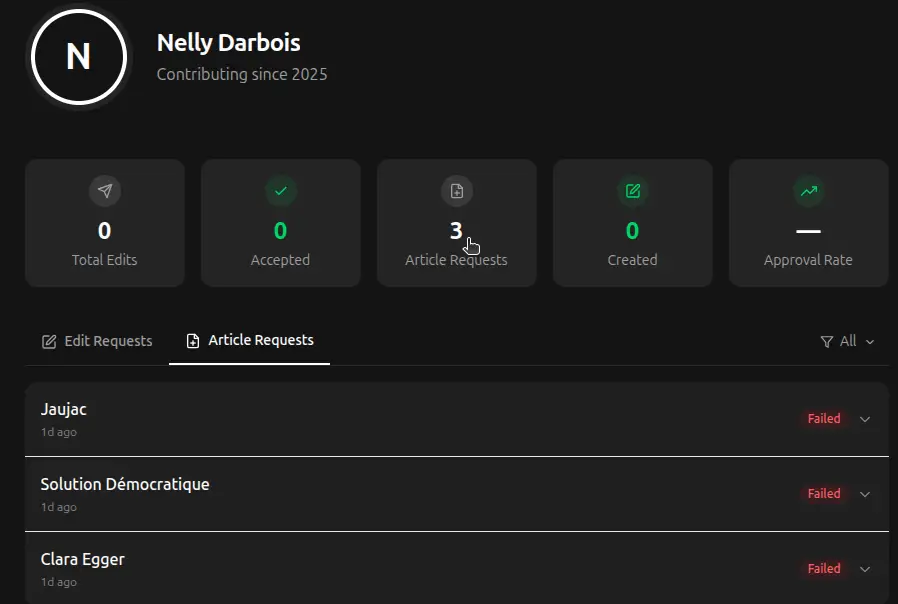
I’ve made several suggestions for articles about people, villages, or organizations, but none of them have led to the creation of a new article so far.
What are the criteria for accepting new articles or updates on Grokipedia?
Grokipedia uses an automated validation system based on Grok artificial intelligence, without any human intervention.
The criteria:
- the quality of the sources,
- the significance of the topic,
- and encyclopedic relevance.
They are not described in detail. In fact, the Grokipedia documentation states:
The specific criteria are not publicly disclosed, which is consistent with a centralized and largely non-transparent editorial model. (source: Grokipedia)
Can you edit a Grokipedia page (and how)?
Just as you can suggest creating a new article on Grokipedia, you can also suggest editing an existing article.
All you need to do is create a (free) account, go to the article, and then click ” Suggest Edit.”
You must fill out a form that includes the following information:
- what information should be changed;
- Please provide the source(s) you’re basing that statement on, including a URL.
Changes are potentially approved by the AI and may appear online within a few hours. Again, my experience—and that of most internet users, based on what we’ve read—suggests that only a very small percentage of suggested changes are accepted.
Sign up for my newsletter if you’d like to stay up to date on any developments at Grokipedia—just like with Wikipedia!

Written by Albin Guillaud
A Wikipedia contributor since 2014, with Wikiconsult I support businesses, institutions, public figures, and agencies looking to create, update, or monitor their presence on Wikipedia.