
Are you hearing more and more about knowledge graphs in the SEO, digital, and AI worlds? These relational databases are now at the core of Google, Wikipedia/Wikidata, and even AI models like ChatGPT.
👉 In this article, we explain :
- what a knowledge graph is,
- the differences between the main players (Google, Wikidata, Golden, Crunchbase…),
- their role in SEO, Knowledge Panels, and LLMs,
- and how your organization can leverage them for online visibility.
Definition: What is a Knowledge Graph?
A Knowledge Graph is a way of organizing information so that it is structured, interconnected and machine-readable.
In concrete terms, it’s a :
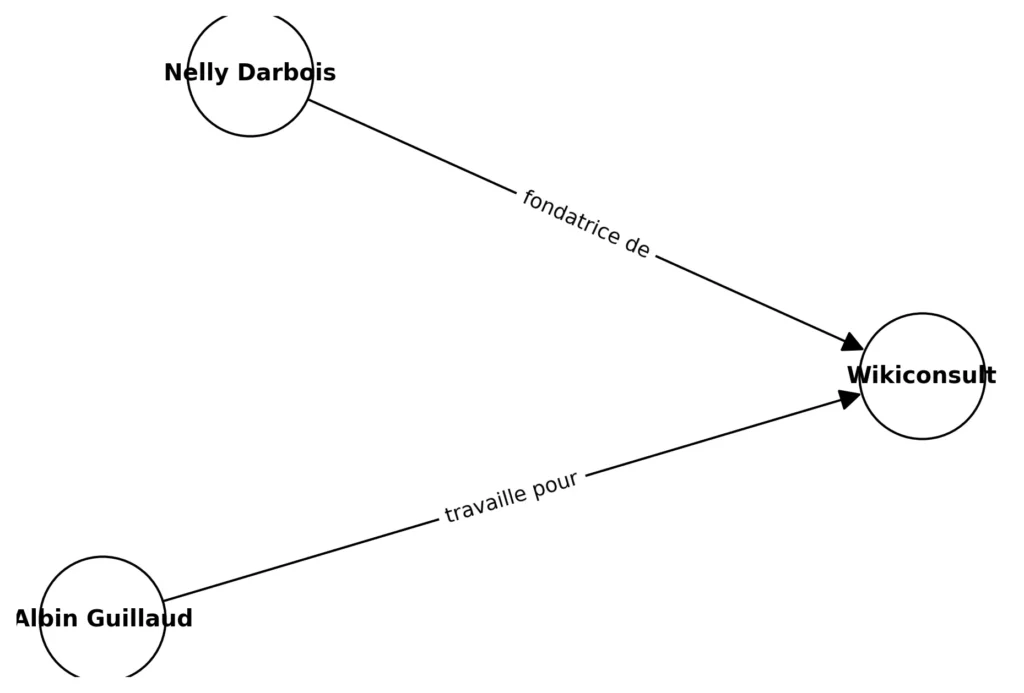
- of nodes (entities: a person, an organization, a place, an event),
- connected by arcs (relations: “works for”, “located in”, “founded in”).
👉 Example: “Nelly Darbois → founder of→ Wikiconsult”.
The Wikiconsult entity can also be linked in the same graph to the “Albin Guillaud” entity, but with a different relationship: “Albin Guillaud →works for → Wikiconsult”
This is no longer just isolated data. It is knowledge tied to other pieces of information.
A Graph-Structured Knowledge Base
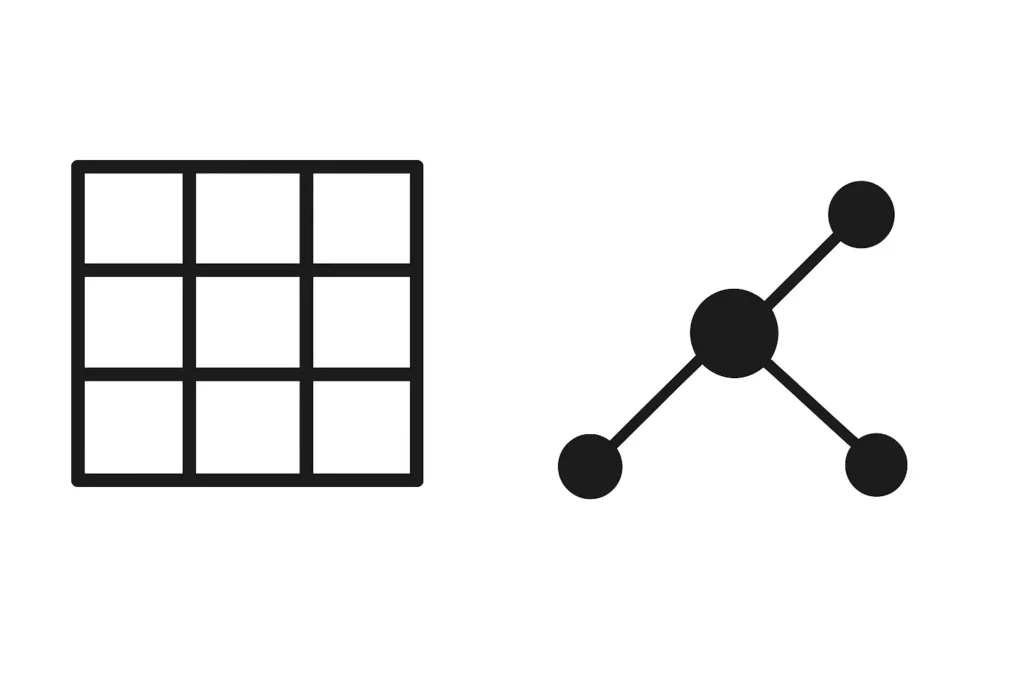
Unlike a traditional table-based database (like Excel), a graph represents connections.
This makes it possible to navigate knowledge like a network.
Origins and Evolution
As early as the 1980s, projects like WordNet—developed by linguists—were already linking words and their relationships.
But the concept exploded in 2012 with the launch of Google’s Knowledge Graph, used to improve search results.

The Main Knowledge Graphs and Their Key Players
Here are the projects and companies that use knowledge graphs the most.
Google Knowledge Graph: The Best-Known, SEO-Oriented
This is the most visible in daily life. It powers Knowledge Panels (those boxes on the right side of Google desktop results).
👉 Example: type “Nicolas de Condorcet” into Google, and you’ll get a direct link to his portrait, dates, places and associated events.
Wikidata and Wikipedia: The Open, Collaborative Base
Wikidata is a free, collaborative project linked to Wikipedia.
- Over 100 million structured elements,
- Available in over 300 languages,
- Used by institutions, researchers and companies.
It’s the backbone of the open knowledge ecosystem.
✍️Need help making edits on Wikipedia?
We can answer your questions for free via email, or you can hire our services for personalized support on the encyclopedia. Take advantage of our 12+ years of experience on Wikipedia!
Golden, Crunchbase, and Other Proprietary KGs
Some companies develop their own graphs:
- Crunchbase for start-ups and investment,
- Golden for innovation and market intelligence.
Other Uses: Voice Assistants, AI, Social Networks
Knowledge graphs aren’t just useful for Google. They’re everywhere.
- In Alexa, Siri, Gemini, voice assistants, to answer questions asked orally by users.
- In social networks to map our relationships: LinkedIn Knowledge Graph (mapping professional relationships and skills), Facebook Social Graph (representing social connections, friends, interests, events).
- On Amazon: the Amazon Product Graph links products, categories, reviews and buying behavior.
- On YouTube, suggested videos use knowledge graphs to recommend content based on user searches.
- In generative AI such as ChatGPT, the results of a knowledge graph often appear in the form of code. Without specific training, it’s difficult to understand and exploit them. Large language models (like ChatGPT) bridge this gap: they translate your questions into technical language, query the graph, then give you a clear answer, in everyday French.
💡 Knowledge graphs contain the reference information LLMs rely on when generating answers. This is why being present in these reference systems is crucial—especially as professionals and individuals increasingly use LLMs!
How Knowledge Graphs Impact Your Online Visibility
Knowledge graphs strengthen your online visibility because they structure information about you and make it available everywhere: Google, Wikipedia, ChatGPT, etc.
👉 Example for a startup: being listed in Crunchbase or Wikidata increases the chances of appearing in a Google Knowledge Panel or being mentioned by ChatGPT. Investors, partners, or clients instantly see key info (founding date, founders, funding rounds), boosting credibility.
👉 Example for an executive: having a well-connected profile on Wikipedia and Wikidata can generate a personal Knowledge Panel. Journalists, clients, or recruiters searching the person’s name in Google instantly see their role, publications, interviews—strengthening authority.
👉 Example for an e-commerce site: a user asking ChatGPT for help choosing a new watch…
How Your Organization Can Benefit
Here are actions you can take to optimize your presence in knowledge graphs.
Be Present in Wikidata and Wikipedia
The first step is simple: check whether your organization is already listed in Wikidata and Wikipedia.
- If so, data quality and accuracy must be ensured.
- If not, you’ll have to work hard tointegrate into this ecosystem, provided you’re eligible.
Check your eligibility for Wikidata, and find out how to create a corporate Wikipedia page.
✍️Delegate the creation of your Wikidata entry
We create and upload your Wikidata record so that its data is taken into account by the algorithms of the major search engines, voice assistants and generative artificial intelligences.
Connecting your data to the right ecosystems
Engines and AIs read data better when it’s structured. Use schema.org tags on your corporate site for events, key people or publications.
👉 As specialists in Wikipedia, Wikidata and SEO, we support companies and institutions in integrating these still little-known levers on the French market, in conjunction with your SEO and communications teams. Contact us for more information.

Written by Albin Guillaud
A Wikipedia contributor since 2014, with Wikiconsult I support businesses, institutions, public figures, and agencies looking to create, update, or monitor their presence on Wikipedia.